LEV Systems Design Consultants

The UK’s only independent LEV design consultancy for regulated and high-hazard industries.
MECHON design local exhaust ventilation systems for the full range of airborne hazards generated by manufacturing.
Our work covers dust extraction and fume control for particulate-generating processes, and vapour extraction for operations emitting volatile organic compounds (VOCs) and other solvents – from coating and printing to cleaning, degreasing and chemical manufacture.
When we design your LEV system, the specification is based entirely on what your process requires and what the regulations demand, not on what equipment we have a supply agreement to sell. That means you go to competitive tender with a design that truly serves your project.
Many of our clients come to us after a design-and-build solution has underperformed, or after a thorough examination has flagged that their LEV system is not providing adequate control.
Types of LEV System We Design
Dust Extraction and Fume Control
Dust Extraction and Fume Control
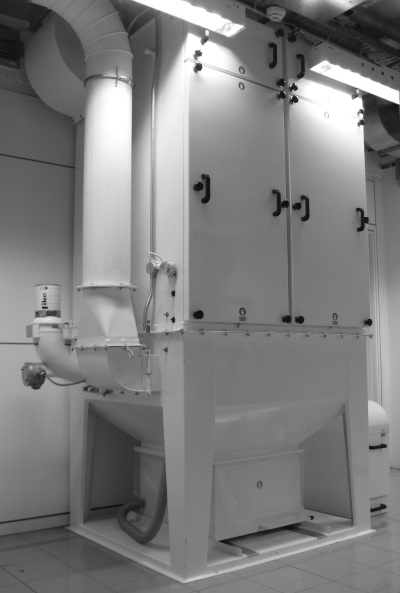
Dust and fume are both forms of airborne particulate – solid particles released into the air during manufacturing processes. The difference is size. Dust particles are visible and settle whereas fume particles are invisible to the naked eye, smaller than one micron, and penetrate deep into the lungs.
Both are harmful, and both need to be captured before they reach the people working nearby.
The consequences of getting this wrong are serious, as overexposure to dust and fumes causes occupational asthma and chronic lung disease.
While workplace accident fatalities in the UK continue to fall, deaths from occupational disease remain persistently high – which is why correctly designed extraction is one of the most important investments a manufacturer can make.
MECHON designs dust and fume extraction systems for a wide range of manufacturing processes, including welding fume extraction, wood dust LEV, silica dust control for grinding and cutting operations, and soldering fume extraction for electronics assembly. We design each system around the specific process and substances involved – because fume applications require higher capture velocities and finer filtration than bulk dust extraction, and treating them the same way produces systems that underperform.
Our dust and fume extraction systems serve clients across aerospace, automotive, pharmaceutical, food, chemical and woodworking manufacturing. Where cleanroom environmental control is needed alongside LEV – common in pharmaceutical and aerospace settings – that work is covered under our cleanroom HVAC design service.
Dust and Fume Case Studies
GKN Aerospace
Aluminium Dust Control on CNC Profiling Machine
Formula 1
Dust Control System for Aluminium SLM Facility
Transport Research Lab
Road Surface Test Lab LEV Systems
Dust Booth
Environmental Control Booth for Carbon Fibre Cutting
Wet Scrubbing
Removal of harmful gases from flammability testing facility
Laboratory Cabinets
Laboratory Expsoure Control. Safety Cabinets and Curing Ovens
Vapour Extraction
Vapour Extraction
Vapour extraction is a different engineering problem from dust and fume.
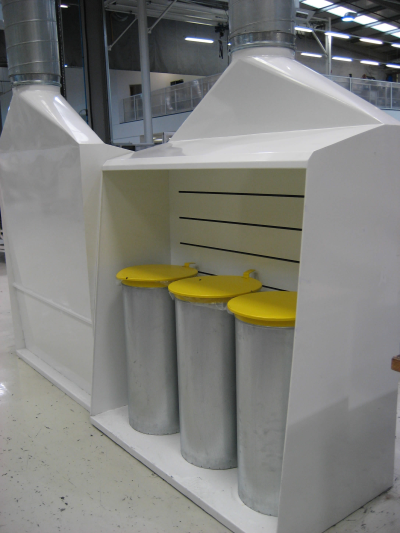
Where dust and fume are solid particles carried in air, vapour extraction captures gaseous contaminants – principally volatile organic compounds (VOCs) and other solvents that evaporate from coating, printing, cleaning, degreasing and chemical manufacture.
Many solvents are harmful at low concentrations and are also flammable or combustible, so vapour extraction design frequently sits alongside DSEAR assessment and hazardous area classification.
Because vapour is a gas rather than a particle, conventional bag or cartridge filtration doesn’t apply. The extracted air stream usually needs abatement before it can be discharged to atmosphere.
MECHON’s air pollution control capability covers thermal oxidation, wet scrubbing, activated carbon and condensation systems, so the vapour extraction design and the abatement design are produced as a single coherent specification.
Vapour Extraction Case Studies
VOC Control
Control of airborne solvents for site manufacturing high performance cars
VOC on Coating Lines
Control of solvent exposure and explosion limits on coating ovens
High Vacuum LEV Systems
High Vacuum LEV Systems
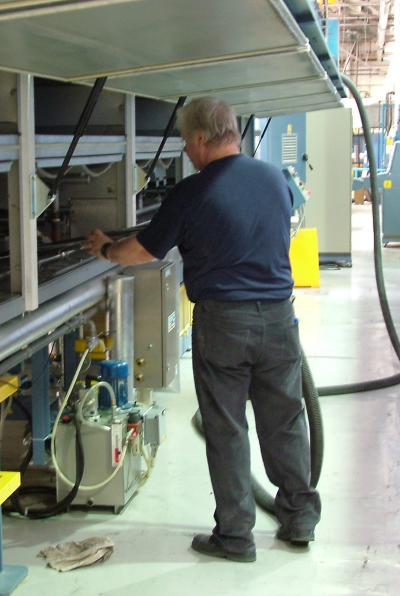
High vacuum LEV systems are used where conventional extraction hoods can’t get close enough to the source of contamination.
Rather than capturing airborne dust after it has dispersed, they extract directly at the point of generation – delivering precise, high-velocity control at the tool, torch or tip.
There are three main application types:
On-tool extraction: for grinding, sanding and other abrading processes.
Extraction is integrated directly into the tool, capturing silica, metal dust or wood dust before it reaches the operator’s breathing zone.
On-torch extraction: for MIG and TIG welding.
Extraction is built into the welding torch, capturing fume at the arc. This is particularly important given that welding fume is classified as a Group 1 carcinogen.
Tip extraction: for soldering.
Small-bore extraction at the soldering iron tip captures flux fume and solder aerosols directly at source, where exposure limits are easily exceeded without dedicated control.
Centralised vacuum cleaning systems serve a different purpose. They remove dust accumulations from surfaces or convey powder spillages to a central collection point, eliminating the exposure risk that manual cleaning creates.
MECHON designs high vacuum LEV systems across all these application types, selecting and specifying the right approach for the process and substances involved.
High Vacuum Case Studies
Akzo Nobel
Centralised vacuum system for paint powder control.
Harsco
Slag Recovery Central Vacuum Cleaning System
Get in Touch with Our Highly Qualified LEV Consultants
LEV Design Management and Validation
Our in-house team of highly qualified design consultants and process engineers delivers complex exposure control solutions within strict cost and programme constraints.
We are deliberately independent – we do not manufacture equipment, we do not install systems, and we hold no commercial relationships with any manufacturer or contractor.
Every recommendation we make is based entirely on what your process actually requires, not on what we have to sell.
That independence also shapes how we approach the problem.
Rather than defaulting straight to LEV, we work through the full hierarchy of control – considering whether exposure can be eliminated, substituted or contained before specifying an extraction system.
This means our clients get the right solution, not just the most obvious one.
Where projects require both extraction and process ventilation, our manufacturing HVAC design capability covers both disciplines within a single independent specification.
Designing LEV and HVAC together means make-up air volumes, pressure regimes, thermal loads and filtration are all resolved at the design stage rather than patched together after installation.
This integrated approach also opens significant energy recovery potential, which is very difficult and significantly more expensive to retrofit.
Understanding the extract air stream – what’s in it, at what concentrations, and what filtration it needs – has to happen at the front end of design. That’s the only realistic point at which energy recovery can be properly integrated.
MECHON’s six-stage LEV design process
MECHON’s design process follows a structured six-stage methodology aligned to both the RIBA Plan of Work and BSRIA BG6 – the industry-standard framework for design management in building services.
Every project follows the same stages, giving clients a clear, auditable process from initial assessment through to final validation.
For regulated-sector clients in defence, pharmaceutical and aerospace, that documented design trail is a procurement requirement.
For client-side project managers, it provides the evidence they need for their own design-management checks.
1. Risk Assessment (Assess)
We start by understanding the processes, substances and exposure risks that will drive the design.
Where substances are flammable, combustible or present an environmental risk, we bring in DSEAR and air pollution assessment at this stage rather than treating them as separate workstreams.
Where the client has an occupational hygienist, we work alongside them, using their monitoring data to inform the brief.
2. Concept Design
We develop the brief collaboratively and present viable design concepts, comparing each against technical, risk and budget parameters.
Concepts are evaluated on whole-life cost – installed, operational and capital – so the client chooses a solution that makes sense over the long term, not just at the point of installation.
3. Spatial Design (Develop)
We work out how the system fits into the facility, including ductwork routing, equipment locations, service clearances, and coordination with other disciplines.
Most projects involve 3D modelling at this stage, with full BIM where the project requires it.
Nothing is committed to detailed design until the spatial picture is resolved.
4. Detailed Specification (Detail)
We produce a full technical specification for competitive tender, covering performance criteria, test requirements and materials schedules. This is the document the client takes to market.
5. Construction
We support contractor procurement and remain accountable for the design throughout – responding to design queries, attending site inspections, and ensuring the contractor builds to our specification.
6. Handover
We verify the contractor’s submissions and equipment selections against our specification before installation begins, then validate the completed system on site.
The result is documented evidence of compliance under COSHH Regulation 9, supporting the client’s ongoing examination and monitoring programme.
Because the design is produced independently before any contractor is appointed, clients go to tender with a specification that reflects their exposure control requirements – not a contractor’s stock list.
When to Call in an LEV Consultant
Your LEV system has failed its thorough examination
Under COSHH Regulation 9, LEV systems must be thoroughly examined and tested (TExT) at least every 14 months – more frequently for certain substances.
When an occupational hygienist or competent examiner finds that your system is not adequately controlling exposure, you have a legal obligation to act.
If the problem is a design fault rather than a maintenance issue, remedial action alone won’t fix it. You need an independent design review.
You are planning a new process or facility
New manufacturing processes, changes to existing operations, and facility expansions all require LEV systems to be designed from the outset, before any contractor is appointed.
Engaging an independent LEV consultant at RIBA Stage 1 or 2 ensures the specification is driven by your exposure control requirements, not by what your ventilation contractor prefers to install.
Your design-and-build solution is underperforming
MECHON is regularly brought in to investigate LEV systems that are failing to control exposure adequately. In many cases, the design was produced by the contractor who also installed and supplied the equipment.
An independent assessment identifies the root cause – whether that is a design flaw, an installation problem, or a fundamental mismatch between the system and the process – and produces a corrected specification that can be tendered competitively.
You have received an HSE improvement notice
An improvement notice requires you to demonstrate compliance within a set timeframe.
The HSE will want to see evidence of a properly engineered solution, not a temporary fix. We help clients respond to enforcement action with independently designed LEV systems that satisfy the regulator and resolve the underlying exposure problem.
You don’t trust your thorough examination results
Thorough examinations are designed to verify system performance against benchmarks, but they don’t always give you the engineering-level diagnosis that serious compliance issues require.
We’re regularly called in by end-users and contractors who have doubts about an examination result – either because the report passed a system they know is causing exposure concerns, or because it failed a system they believe should pass with proper risk-based assessment.
We frequently work alongside occupational hygienists who have identified a compliance concern through their exposure monitoring or sampling programme and need independent engineering input to specify the fix.
Our design expertise complements their monitoring and examination work, and we are the engineering partner that hygienists call on when the problem they’ve identified needs a properly specified engineering solution.
Where examination has been too lenient, we identify and quantify the real performance gap. In one recent example, a system reported as 90% compliant actually reached 50% on independent audit.
Where it has been too conservative, we apply risk-based engineering assessment that standard benchmarks don’t always capture; for example, ductwork transport velocity, where HSG258 sets a default of 10 m/s but BS EN 14175 sets fume cupboards at 6 m/s, and competent designers can overrule the higher figure on engineering evidence.
Site-wide compliance audits are a natural extension of this work, and we often remain involved on those sites for years as identified issues are resolved one by one.
If you have concerns about an examination result or want a site-wide independent audit, speak to one of our consultants.
Get in Touch with Our Highly Qualified LEV Consultants
LEV Systems Design Across High-Hazard Industries
MECHON’s LEV systems design work spans some of the UK’s most demanding industrial sectors.
Our engineers hold BOHS P602 qualifications, with hands-on experience designing local exhaust ventilation for complex manufacturing environments across:
Aerospace
Site-wide LEV audits and system redesign for BAE Systems across multiple UK sites, including the principal LEV consultancy role on a major £70m ventilation programme. CNC machining dust control for GKN Aerospace.
Automotive
LEV systems and explosion mitigation design for McLaren Racing. Vehicle exhaust exposure control for Bentley Motors. Engine plant LEV redesign for Honda UK.
Pharmaceutical
Laboratory LEV and air handling for Universal Laboratories. Formaldehyde exposure control for Honeywell. LEV systems for pathology laboratories at Blackpool Victoria Hospital and dissection facilities at St George’s Hospital London and the University of East Anglia.
General Manufacturing
LEV and ventilation design for PPG Industries, Akzo Nobel (including international sites in Poland and Sweden), Sika, Infineum and Hempel. Wood dust LEV systems for Masonite Europe. Cadmium and chrome plating LEV for NMB Minebea.
Food and Beverages
Dust control and DSEAR compliance for Jordans Ryvita. Dust explosion mitigation for Molson Coors. LEV system design for Aspall Cyder.
Electronics
LEV systems for gigafactory-scale EV battery manufacturing at Envision AESC GigaOne in Sunderland and the Agratas/JLR Somerset gigafactory.
Packaging and Print
Solvent vapour LEV systems and VOC exposure control for coating and printing operations.
LEV Systems Compliance and Your Legal Responsibilities
LEV systems are governed by several overlapping regulations. The key ones are:
COSHH
The Control of Substances Hazardous to Health Regulations 2002 requires employers to prevent or adequately control exposure to hazardous substances. LEV is one of the principal engineering controls used to achieve this. Under Regulation 9, LEV systems must be thoroughly examined and tested at regular intervals, with records kept for at least five years.
Where an LEV risk assessment identifies inadequate control, employers are legally required to act, whether through remedial maintenance or a full system redesign.
HSG258
The HSE’s primary guidance document for LEV design, covering the design hierarchy, capture velocity principles, hood design, and documentation requirements. All MECHON LEV designs are produced in accordance with HSG258.
Workplace Exposure Limits (WELs)
Where WELs exist in HSE’s EH40 document, the LEV system must demonstrably reduce exposure below the limit.
For certain substances – including carcinogens, mutagens and respiratory sensitisers – exposure must be reduced as far as is reasonably practicable, not just to the WEL.
MECHON cross-references the hazard classification of every substance involved at Stage 1, drawing on ECHA’s Annex VI harmonised classification, the wider C&L Inventory, and the GB Mandatory Classification and Labelling list (GB MCL) administered by HSE under GB CLP, to ensure the right control standard is applied from the outset.
DSEAR and ATEX
Where explosive atmospheres are a risk, MECHON’s LEV designs incorporate hazardous area classification, ATEX-rated equipment selection, and appropriate explosion protection measures, see our DSEAR assessment services.
Every LEV system MECHON designs is produced with these obligations in mind from the outset. If you’re unsure whether your current LEV provision meets your legal requirements, speak to one of our consultants.
FAQs about LEV systems
How often does an LEV system need to be examined?
COSHH Regulation 9 requires LEV systems to be thoroughly examined and tested at least every 14 months. For specific substances – including those listed in Schedule 4 to COSHH (such as vinyl chloride, nitro and amino derivatives of phenol, and certain other carcinogens) – the interval is shorter, at every month or every six months depending on the substance. The examination must be carried out by a competent person, and records must be kept for at least five years.
What does an LEV thorough examination involve?
A thorough examination and test (TExT) assesses whether the LEV system is performing as originally designed and whether it is still achieving adequate control of exposure.
It typically includes visual inspection of all components, airflow measurements at each extraction point, comparison against design specification, and an assessment of whether exposure control is adequate given the substances and processes in use. If the system is found to be inadequate, the employer must take action to remedy the deficiency.
What is the difference between LEV design and design-and-build?
In a design-and-build arrangement, the contractor who will install the LEV system also produces the design. This creates an inherent conflict of interest: the design may be influenced by what the contractor has in stock, what it can source cheaply, or what generates the best margin, rather than what provides optimal exposure control.
Independent LEV design separates these functions.
MECHON produces the technical specification based purely on your exposure control requirements, and the installation is then tendered competitively to contractors who build to our specification.
This typically produces a better technical outcome and a lower installation cost.
Can MECHON design LEV for complex or unusual processes?
Yes. We are regularly brought in on projects that other consultancies or contractors have declined as too technically complex.
Our experience spans highly toxic substances, explosive atmospheres, sub-micron particulate, simultaneous multi-contaminant control, and environments where process and environmental control requirements create competing constraints.
If a project is complex, that is generally when independent design adds the most value.
Can MECHON work alongside my occupational hygienist?
Yes, and we often do.
Many of our engagements start with a hygienist identifying a compliance concern through workplace exposure monitoring, then recommending MECHON as the independent engineering specialist to design the fix.
We treat hygienists’ exposure data as a foundational input to Stage 1 Risk Assessment, and we feed our design specifications back to them so they can continue their monitoring programme with clear performance benchmarks.
Do I still need LEV if my workers wear respiratory protective equipment (RPE)?
Yes, and in most cases, LEV is a legal requirement regardless of whether RPE is in use.
Under the COSHH hierarchy of control, engineering controls such as LEV must be implemented before RPE is considered.
RPE is the last line of defence, not a substitute for adequate engineering control.
If your current control strategy relies primarily on RPE, that is a compliance risk – and one an independent LEV design review will identify and resolve.
How long does a typical LEV design project take from brief to tender-ready?
It depends on the complexity of the project, but as a general guide, a straightforward single-process LEV system typically moves from initial brief to tender-ready specification in eight to twelve weeks.
More complex projects – multi-process facilities, cleanroom-integrated LEV, or systems involving DSEAR assessment or abatement design – typically run to four to six months from Stage 1 Risk Assessment through to the completed Stage 4 Detailed Specification.
MECHON’s structured six-stage methodology means the programme is defined and agreed at the outset, so clients can plan contractor procurement and installation timelines with confidence rather than working to an open-ended contractor estimate.
When should I consider replacing an existing LEV system rather than upgrading it?
Replacement becomes the right answer when the fundamental design is wrong rather than when individual components have worn out.
If a system has repeatedly failed its thorough examination despite maintenance and remedial work, if exposure monitoring shows workers are consistently over-exposed even when the system is running correctly, or if the process it serves has changed significantly since the system was originally designed, upgrading is unlikely to resolve the root cause.
MECHON is regularly brought in to carry out independent assessments on systems that have had repeated remedial investment without improvement – in many cases, the diagnosis is that the original design was never adequate for the process.
An independent assessment identifies whether the problem is one of maintenance, installation, or fundamental design, and gives you an honest answer on whether upgrade or replacement represents better value over the system’s remaining life.